
On 30 March,2026
Prepared by: Rohingya Human Rights Initiative (ROHRIngya), New Delhi, India
Coverage Period: April 2024 – January 2025
Methodology: Based on 48 survivor interviews including men and women conducted across Bangladesh, Myanmar, Malaysia, and Thailand
Overview
The Rohingya Human Rights Initiative (ROHRIngya) has produced a comprehensive 111-page research report documenting widespread and systematic human rights violations committed against the Rohingya community in Rakhine State (Arakan State), Myanmar. The report presents evidence that the Arakan Army (AA) and the United League of Arakan (ULA), while engaged in armed conflict with the Myanmar military junta, have simultaneously carried out acts that amount to war crimes and crimes against humanity targeting the Rohingya population, which has predominantly resided in Rakhine State (Arakan State), Myanmar for centuries.
Drawing on first-hand testimonies, the report highlights patterns of violence, including forced conscription, mass displacement, destruction of civilian infrastructure, village burnings, the rape of women and minor girls, and financial extortion by the Arakan Army (AA). These actions are presented as part of a broader, organized campaign that has severely undermined the safety, dignity, and survival of the Rohingya community in Rakhine State (Arakan State), Myanmar.
Key Findings
1. Movement Restrictions and Territorial Control
The Arakan Army (AA) and the United League of Arakan (ULA) have established strict control over Rohingya-populated areas by imposing movement restrictions, checkpoints, and surveillance measures after taking control of 14 out of 17 townships in Rakhine State (Arakan State). Entire villages and towns have effectively been transformed into confined zones, severely limiting access to livelihoods, healthcare, and humanitarian assistance.

This is a picture of an Arakan Army checkpoint. Several people with motorbikes can be seen. At the end of the road, there is an Arakan Army checkpoint. The photo was taken in Shew Za Village, Maungdaw Township, Rakhine State. Credit: R4R Private source.” 26 February,2026
Forced relocations and geographic segregation have further isolated Rohingya communities and weakened their social and economic structures across Rakhine State, Myanmar. The Arakan Army requires Rohingya Muslims to obtain a “Tokkenza” (travel pass) from designated village authorities, often in exchange for significant payments. Strict punitive measures are imposed on those who fail to obtain this pass, including arrest.
In addition, the Arakan Army continues systematic screening of Rohingya residents in villages by photographing individuals and recording detailed family information, for which fees are also reportedly charged. Furthermore, curfews have been imposed in Rohingya-populated areas, further restricting freedom of movement and daily life.
2. Targeted Violence and Atrocities
The report documents numerous incidents of targeted killings, shelling, and coordinated attacks on Rohingya villages and towns, particularly in Buthidaung and Maungdaw townships, carried out by the Arakan Army and the Myanmar military junta. Civilian infrastructure, including homes, mosques, schools, bridges, and medical facilities, has been deliberately destroyed through arson and bombardment.
Victims are frequently accused of having affiliations with the Myanmar military, often without evidence, and are subjected to lethal violence and widespread destruction.
3. Forced Displacement and Family Separation
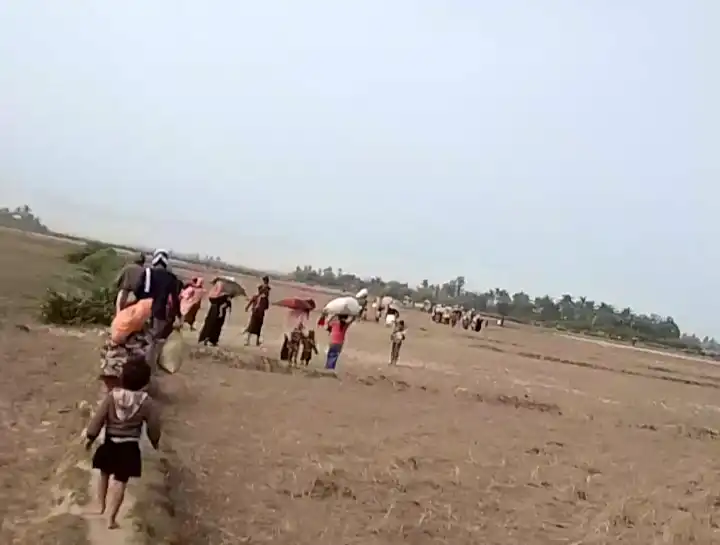
Escalating violence has forced hundreds of thousands of Rohingya to flee their homes. Testimonies from displaced refugees across multiple countries reveal widespread family separation, with many individuals unaware of the whereabouts or fate of their relatives. Displacement has resulted in prolonged humanitarian vulnerability and uncertainty for the Rohingya community.
Many Rohingya are compelled to undertake precarious sea journeys to reach countries such as Thailand, Malaysia, Sri Lanka, India, and Indonesia. Reports indicate that a significant number of individuals have died at sea during these journeys, while others have been subjected to illegal detention or fallen into the hands of human traffickers while attempting to escape persecution and violence.
4. Sexual and Gender-Based Violence
The report provides detailed accounts of sexual violence against Rohingya women and minor girls, including incidents of mass rape. These acts are often carried out in the presence of family members, amplifying psychological trauma. The findings indicate that such violence is deliberately used as a tool to terrorize the Rohingya community, dismantle social cohesion, and compel Rohingya Muslims to flee Rakhine State (Arakan State), Myanmar.
5. Forced Conscription and Abductions
Rohingya men, women, boys, and girls have been forcibly recruited or abducted by the Arakan Army, often under the pretext of questioning or security operations. Many are reportedly used as forced labor or as human shields in frontline conflict areas. Families are frequently left without information regarding their fate or whereabouts.
6. Destruction of Property and Economic Exploitation
Entire Rohingya villages have been burned and looted, and houses abandoned due to ongoing violence have been confiscated. The report also documents widespread seizure of land, agricultural resources, and personal property, including ancestral lands and cemeteries.
Additionally, financial extortion has been reported on a regular basis, with civilians forced to pay money under coercion and subjected to forced labor without compensation. The confiscation of communication tools, such as SIM cards, along with the deliberate disruption of internet services, has further isolated Rohingya communities both within Myanmar and abroad.
7. Propaganda and Denial
The report analyzes public communications by Arakan Army leadership, particularly Commander-in-Chief Twan Mrat Naing, and identifies a pattern of denial, narrative manipulation, and double standards reflected in his social media posts and interviews. While he has, on international platforms and in Burmese media, acknowledged the historical presence of the Rohingya in Rakhine State for generations, these statements contrast sharply with the simultaneous subjugation of Rohingya Muslims within Rakhine State (Arakan State), Myanmar.
Despite public claims of inclusivity and the protection of minority rights under the “Way of Rakhita” ideology, the Rohingya are systematically excluded and labeled as outsiders or “Bengali,” thereby reinforcing discriminatory practices.
Historical Context
The report situates these developments within a broader history of systemic persecution against the Rohingya, including the 1982 Citizenship Law, the 2012 communal violence, the 2016 military-led attacks against the Rohingya, and the 2017 mass atrocities widely recognized as ethnic cleansing and genocide committed by the Myanmar military junta, which forced over a million Rohingya into refugee camps in Bangladesh.
The rise and territorial expansion of the Arakan Army since 2019 have introduced a new phase of violence, further exacerbating the already dire conditions faced by Rohingya Muslims in Rakhine State (Arakan State), Myanmar.
Methodology
The research was conducted between November 2024 and January 2025 using both remote and in-person data collection methods. A total of 48 interviews were carried out with individuals aged 15 to 58, including both male and female victims. Interviews were conducted in the Rohingya language by trained researchers, recorded using KoboToolbox, and later translated into English. Ethical standards, including confidentiality and a “Do No Harm” approach, were strictly maintained.
Conclusion and Recommendations
The report concludes that the documented violations constitute serious breaches of international humanitarian and human rights law, including war crimes and crimes against humanity. It calls for urgent international intervention and accountability, urging UN bodies and international mechanisms such as the International Criminal Court (ICC), the International Court of Justice (ICJ), the Organisation of Islamic Cooperation (OIC), and other global institutions to investigate and take appropriate legal action against the Arakan Army (AA).
The findings underscore that the ongoing violence represents not an isolated pattern of abuse, but a continuation of a broader and sustained campaign aimed at the marginalization and potential eradication of the Rohingya population from Rakhine State.
The full PDF report is available.
The Rohingya Human Rights Initiative will also conduct a one-month social media campaign highlighting the ongoing atrocities, war crimes, and human rights abuses against Rohingya Muslims in Rakhine State, Myanmar.
X: @ROHRIngya
Facebook: Rohingya Human Rights Initiative (ROHRIngya)
#stopgenocide #stopviolence #stoprape #stopdiscrimination #stopforceconscription
By Rohingya Human Rights Initiative